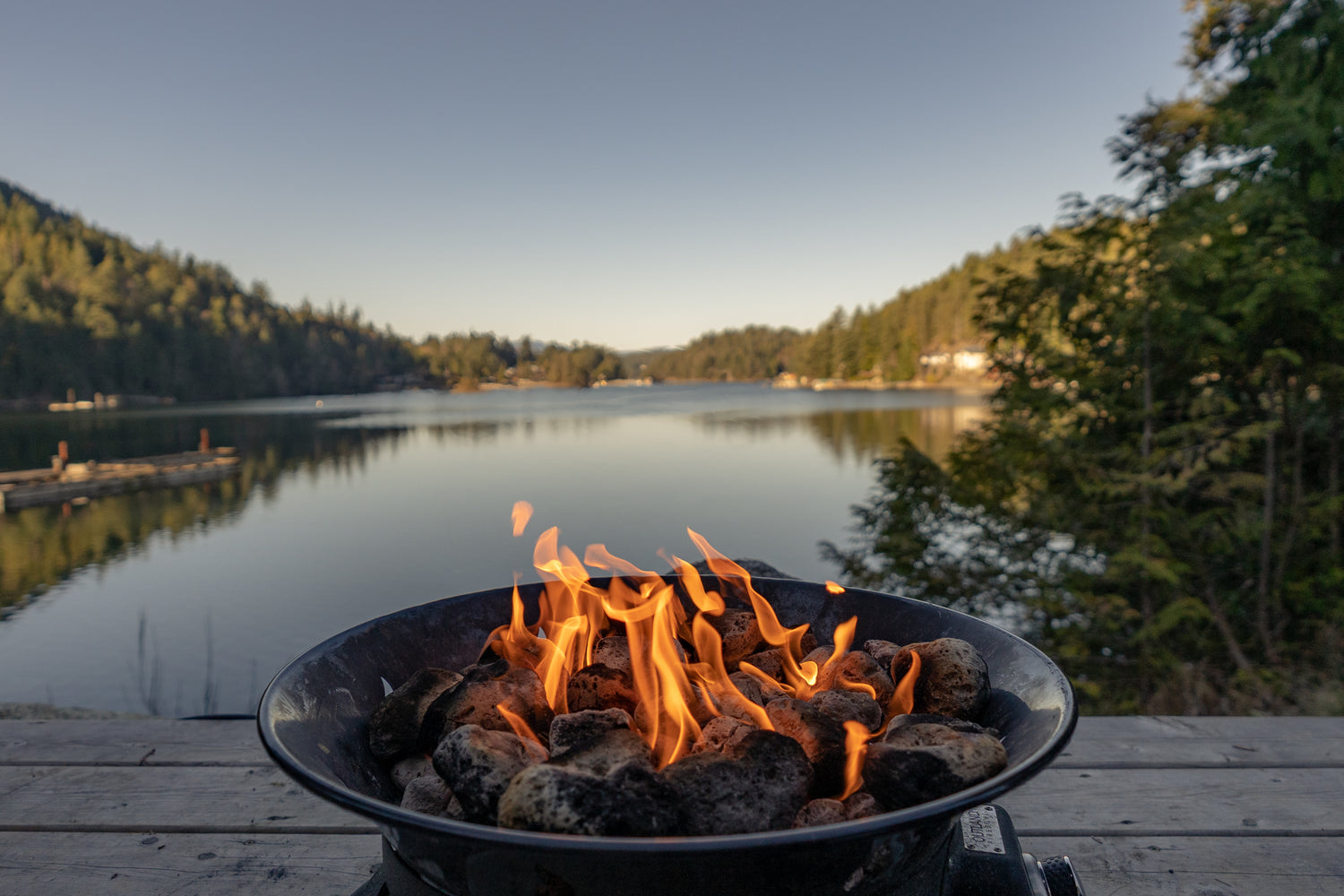
If you want a fire that lights in seconds, makes no smoke and leaves nothing to clear up, buy gas. If you want real flame, real crackle and the cheapest fuel, buy wood. If you want a clean burn indoors as well as out, and you will pay for it, buy bioethanol. That is the whole decision. The rest of this guide shows the numbers behind it.
Updated September 2026 by the Fireside Boutique team. Every output, price and dimension below is taken from the product it describes, not averaged across a brand.
The short answer
| Gas | Wood | Bioethanol | |
|---|---|---|---|
| Time to light | Seconds, push button | 5 to 15 minutes | Under a minute |
| Published heat output | Yes, stated per model | No fixed rating | Yes, stated per model |
| Smoke and ash | Neither | Both | Neither |
| Clearing up | None | Ash after every burn | None |
| Entry price in our range | From £129 | From £56 | From £895 |
| Indoor use | No | No | On certified models only |
What the heat output numbers actually tell you
Most comparisons say gas gives moderate heat and wood gives high heat. That is misleading, and it is worth understanding why before you spend anything.
Gas burners carry a published rating because the burner is engineered to a fixed output. The Happy Cocooning Riviera 80 is rated at 8.5 kW and the Estate Square 88 at 16.5 kW. In BTU terms the Elementi Nantucket is 40,000 and the Elementi Manhattan 45,000, with the larger Elementi tables running to 60,000.
The wood-burning fire pits in this guide carry no such rating, and their manufacturers do not publish one. The heat from a wood fire depends entirely on how much wood you put in it and how dry that wood is, so a generously fed fire bowl will out-heat a gas table, and two damp logs will not. If a retailer quotes you a kW figure for a wood fire pit, ask where it came from.
The practical reading: gas gives predictable, controllable heat you can turn down. Wood gives variable heat you control by feeding it.
Gas: what you get for the money
Gas suits people who light a fire on a weeknight. No kindling, no waiting, nothing to clear afterwards.
The Riviera 80 at £449 is the entry point among proper gas fire pit tables, 80 x 80 x 34 cm and 12.3 kg, built in aluminium and teak and light enough for one person to lift. Step up to the Estate Square 88 at £599 and you gain nearly double the output at 16.5 kW, but it is composite stone and weighs 40.5 kg, so it stays where you put it.
On the Elementi side, the Nantucket is a 67 cm cast concrete bowl at £750 producing 40,000 BTU, and the Manhattan is a 91 x 91 cm table at £1,500 producing 45,000 BTU.
Two honest caveats. On the Happy Cocooning range the regulator and gas bottle are sold separately, so add those to the price. And check convertibility before you buy: the Nantucket is propane only and cannot be converted to natural gas, whereas the Manhattan can.
Wood: what you get for the money
Wood is still the cheapest way into a real fire, and for many people the only kind that counts.
The Moodz Feet and Handle bowl spans £185 to £455 across 60, 80 and 100 cm, so you size it to the space. The BonFeu BonVes 45 at £239.95 is a 45 x 45 x 100 cm basket weighing 13.1 kg, which lifts the fire to eye level in a small courtyard.
If you want the fire to draw smoke upward and away from seating, an outdoor fireplace does that by design. The BonFeu BonTon comes in three sizes, from a 40 x 40 x 145 cm model at £274.95 up to a 60 x 60 x 195 cm version at £515.50, so check which size a quoted price refers to.
And if you want to cook on it properly rather than balance a grill over the flames, the BonFeu Biza Open at £789.50 is an 80 x 80 cm fire pit with an integrated plancha grill.
On wood, the material decides how the piece ages. The BonFeu models are steel and corten steel, and corten develops a rust-toned patina rather than being protected from it. The Moodz bowl is stainless steel, which keeps its finish instead. Cast iron, common at the budget end elsewhere, holds heat well but is heavy and can crack if rain hits it hot.
The trade-offs are real: ash after every burn, dry wood to store, and smoke that goes wherever the wind takes it. That last one catches people out in small gardens.
Bioethanol: the option most comparisons leave out
Bioethanol burns to carbon dioxide and water vapour. No smoke, no soot, no ash to clear, and the fuel is made from renewable plant sources, which makes it the cleanest burn of the three.
The EcoSmart Fire Ark 40 is a 100 cm round table from £2,495 producing 6 kW, or 20,433 BTU, with a 7 to 9 hour burn from an 8 litre fill. At our £65 for a 20 litre carton of e-NRG fuel that works out at roughly £2.90 to £3.70 an hour, so it is the dearest of the three to run as well as to buy.
What you are paying for is flexibility. Certified models work indoors as well as out, and the Ark 40 is certified to EN 16647, the UK and EU standard for indoor bioethanol fireplaces. That certification carries conditions: indoor use requires the model's stated minimum room size, approximately 116 cubic metres on the Ark 40, because the flame consumes oxygen. Clean is not the same as unconditional.
Which should you choose?
Small garden, close neighbours, frequent use. Gas. No smoke to drift over a fence, and light enough to use on a Tuesday. Start with the Riviera 80.
Biggest fire for the smallest budget. Wood, which starts lower than either alternative. A Moodz bowl from £185 buys a stainless bowl you will not replace in a hurry.
You want to cook on it. Wood, on something built for it. The Biza Open has the plancha built into the design rather than added as an afterthought.
Entertaining on a cold night. Size it properly: on gas that means the 16.5 kW Estate Square 88, not the 8.5 kW Riviera 80.
One fire that works indoors and out. Bioethanol, on a certified model, room volume checked first.
If you are genuinely torn, we recommend a small gas pit for weeknights and a larger wood bowl for weekends, which together usually cost less than one high-end table.
Before you buy: two things worth checking
Your local smoke control status. If you are set on wood, confirm the rules for your address first. The Government's smoke control area rules set out what may be burned and where, and enforcement sits with your local council.
How the gas is connected. Bottled propane needs no installation, but a permanent natural gas connection is work for a registered engineer, and the Health and Safety Executive publishes the requirements for domestic gas work.
Featured in this guide


Frequently asked questions
Q: Is a gas fire pit warmer than a wood one?
A: Not necessarily. Gas models publish a fixed output, from 8.5 kW on the Happy Cocooning Riviera 80 up to 16.5 kW on the Estate Square 88. A wood fire has no fixed rating because its heat depends on how much wood you burn, so a well fed wood fire can run hotter while a small one runs cooler.
Q: Which is cheaper to run, gas or wood?
A: Wood is usually the cheaper fuel, but gas leaves no ash to clear and no wood to store. Bioethanol is the dearest of the three: an 8 litre fill of the EcoSmart Fire Ark 40 burns for 7 to 9 hours and costs about £26 at our £65 price for a 20 litre carton of e-NRG, so roughly £2.90 to £3.70 an hour.
Q: Can I use a wood-burning fire pit in a UK smoke control area?
A: Smoke control rules restrict what you may burn and what you may burn it in, and they are enforced by your local council. Check the GOV.UK smoke control guidance and your own council before buying a wood-burning model. A gas or bioethanol fire produces no wood smoke, which avoids the question entirely.
Q: Do gas fire pits come with the gas bottle?
A: No. On the Happy Cocooning range the regulator and bottle are sold separately, so budget for both. Check convertibility too: the Elementi Nantucket is propane only and cannot be converted to natural gas, while the Elementi Manhattan can.
Q: What suits a small garden with close neighbours?
A: Gas or bioethanol. Both burn without smoke or ash, so nothing drifts over a fence. A compact gas table such as the Riviera 80 at 80 x 80 x 34 cm suits a small terrace, and at 12.3 kg one person can reposition it.