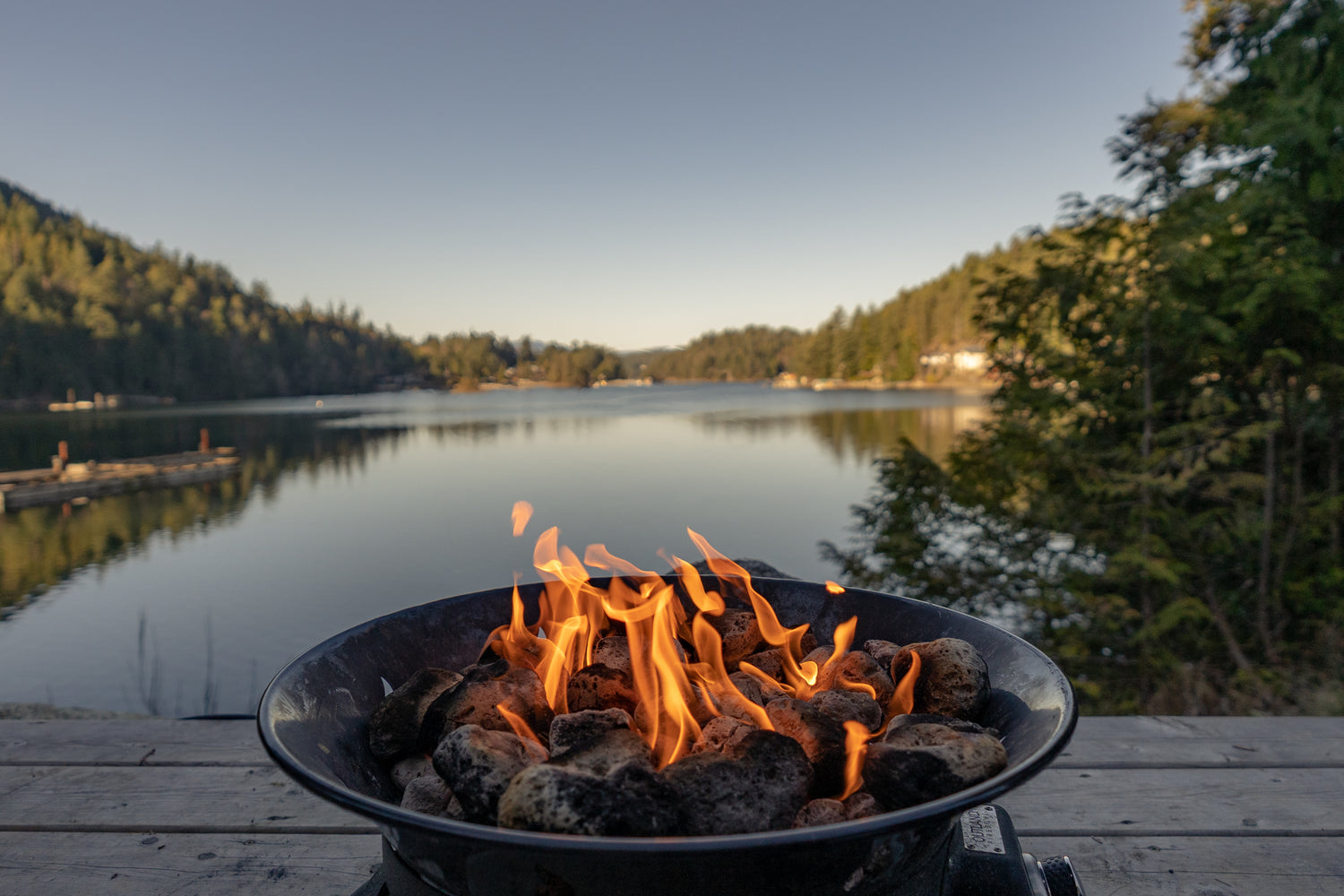
The secret to a reliable fire pit fire is three things: kiln-dried hardwood, a structure that allows that allows airflow, and starting small. Use kiln-dried hardwood with a moisture content below 20%, build a tepee of kindling over natural firelighters, light from the base, and resist the urge to add large logs too early. Most fires that fail do so in the first 3 minutes.
What you need before you start
The difference between a fire that catches in 5 minutes and one that smoulders for 30 comes down to 3 things.
Kiln-dried hardwood. This is the primary factor. Wood with a moisture content above 20% will not sustain a fire , it absorbs too much heat in the process of boiling off water. Buy kiln-dried hardwood in nets or bags from a reputable supplier; it arrives at 12–15% moisture and burns cleanly from the first log. Oak is a reliable all-round choice for fire pits: long burn time, steady heat, minimal smoke. Ash burns well even slightly green and catches easily. Birch lights fast but burns through quickly , good for starting, but burns through faster than oak or ash.
Natural firelighters. Wax-coated wood wool cubes or compressed sawdust blocks. Not lighter fluid. Lighter fluid burns off before the kindling catches and leaves a chemical smell that lingers on food cooked nearby. Natural firelighters produce a sustained flame at exactly the temperature needed to ignite kindling.
Fine kindling. Finger-thin sticks , no thicker than your index finger , that will catch from the firelighter and transfer enough heat to the first logs. A BonFeu BonBowl Plus or Moodz Classic Corten fire pit bowl comes with a mesh base that lifts the fire off the ground , this bottom airflow matters as much as the wood itself. At Fireside Boutique, we supply kiln-dried hardwood accessories alongside each fire pit, every order ships with enough starter kindling for the first three lights.
Optional but useful: a long barbecue lighter or extra-long matches (standard matches put your fingers too close to the flame), a poker for rearranging logs, and bellows if you want to encourage a struggling fire without blowing on it.
Step-by-step: lighting a fire pit fire
Step 1. Check the wind direction and position your fire pit so the mesh opening faces into it. Airflow from below is what sustains the burn.
Step 2. Place 2–3 natural firelighters in the centre of the bowl.
Step 3. Build a tepee of fine kindling over the firelighters: 8 to 12 sticks leaning inward at about 45 degrees, touching at the top, with enough gaps between them for air to circulate. The tepee shape channels heat upward onto itself as the kindling catches.
Step 4. Light the firelighters at their base with a long match or barbecue lighter. One light per firelighter is enough if the wood is dry.
Step 5. Wait. The kindling needs 3 to 4 minutes to establish a proper flame before you add anything larger. This is where most fires fail , people add logs too early, smother the heat, and lose the fire. Watch until the kindling is burning steadily from the base.
Step 6. Lay 2 medium logs (roughly 10cm diameter) across the kindling in a loose log cabin pattern , parallel to each other, not stacked. The air gap between them is the key.
Step 7. Once those logs are burning from the inside (another 10 minutes), the fire is self-sustaining. Add 1 or 2 logs every 20 to 30 minutes, maintaining the gap structure. A 60cm fire pit bowl like the BonFeu BonBowl burns comfortably on 4 to 6 logs at a time.
Common mistakes and how to avoid them
Wet wood. The single most common reason a fire pit fails. Wood stored outdoors under a tarp still holds significant moisture, especially in a British winter. If you have any doubt about your wood's moisture content, buy a wood moisture meter , they cost under £15 and remove all guesswork. Read more than 20% on the display: do not use it.
Too many logs too quickly. Adding large logs before there is a solid base of embers starves the fire of oxygen. Build gradually , kindling first, then medium logs, then larger pieces only when the fire is clearly established.
Lighter fluid. It produces a burst of flame that feels encouraging, burns off in seconds, and rarely transfers to the kindling. The smell it leaves in the air and on food is unpleasant. Natural firelighters are slower to light but far more reliable.
Blocked airflow. Ash from previous fires can clog the mesh at the base of a fire pit bowl. Empty and brush out the ash before lighting. A completely blocked mesh can make even good wood nearly impossible to keep burning.
Keeping the fire going
A well-managed fire pit on kiln-dried oak burns for 2 to 3 hours on a standard basket of logs. The rhythm: add 1 or 2 logs every 20 to 30 minutes, laid loosely across the existing burn so air circulates underneath. Do not stack logs flat , the lack of airflow between them will cool the fire.
If the fire starts to die down unexpectedly, check the airflow first (use a poker to create gaps), then add a piece of dry kindling to boost the temperature before adding another log. Bellows are the most effective tool for encouraging a struggling fire without disturbing the structure.
Gas versus wood: the honest comparison
If the fire itself is not part of what you enjoy , if you want heat and atmosphere without preparation , gas is the more practical choice. A gas fire pit reaches full temperature in under 2 minutes, requires no kindling, produces no ash, and extinguishes instantly. It is the right answer for smoke-controlled postcodes, for balconies, and for households who want the look and warmth of an outdoor fire without the management overhead.
Wood is the right choice if the building, the watching, and the occasional adjusting are part of what you enjoy about an evening outdoors. The crackling, the scent of burning oak, the way the flame responds to a puff of wind , none of that is available from a gas burner. The two serve different moods.
Frequently asked questions
What is the best wood for a fire pit? Oak and ash are the best hardwoods for sustained heat. Oak burns slowly and produces a strong, steady flame; ash burns well even slightly green. Birch is good for starting a fire but burns through quickly. Avoid softwoods (pine, spruce) , they produce more sparks, more resin, and more soot than hardwoods.
How long does it take to light a fire pit? With kiln-dried wood and natural firelighters, a stable base fire takes 5 to 8 minutes. Add another 10 to 15 minutes for the first logs to reach a good burning temperature. If it is taking longer, the wood is likely too wet or the airflow is blocked.
Can you use a fire pit in the rain? Light rain will not extinguish an established fire, but it suppresses the temperature and can produce heavy steam-smoke. Starting from cold in rain is difficult. If you use your fire pit regularly through the British seasons, a weather-resistant design like a Corten steel bowl , or a chiminea with a covered top , handles wet conditions significantly better.
How do I stop my fire pit from smoking? Smoke is almost always caused by wet wood. Switch to kiln-dried hardwood with a moisture content below 20%. If the fire is already burning and still producing heavy smoke, create more airflow by rearranging the logs with a poker, or use bellows to raise the temperature , a fire burning above 300°C produces very little visible smoke.